

On March 21, the International Day for the Elimination of Racial Discrimination, institutions across Canada will reaffirm their commitment to equity. Commitments matter. But the durability of those commitments depends on the definitions that guide policy. If our understanding of anti-Black racism remains rooted in an earlier moment, our responses will remain limited to it. Modernization begins with language.
In 2003, Dr. Akua Benjamin, retired director of the School of Social Work, Toronto Metropolitan University, offered Canada a definition of anti-Black racism that shifted the national vocabulary. She named what had long been treated as incidental. She rooted anti-Black racism in the history of enslavement and its afterlife in Canadian institutions. Her words moved from scholarship into policy. Governments adopted them. Schools cited them. Non-profits built frameworks around them. For more than two decades, her definition has carried weight.
History, however, does not stand still. Neither does racism.
Over the past twenty years, the cultural industries have globalized. Black communities in Canada have grown more ethnically and culturally diverse. The language of systemic inequity has entered boardrooms and regulatory hearings. We now speak more openly about structures, power, and white supremacy. In consultations for the Black Screen Office’s Anti-Black Racism Policy Framework, one question surfaced early: does our shared definition still capture how anti-Black racism operates today, particularly within the cultural industries?
The answer was clear. The definition must evolve.
It must name colonialism alongside enslavement. It must acknowledge that Black communities are not monolithic, and that immigration status, language, religion, gender identity, sexual orientation, and ability shape how anti-Black racism is experienced. It must recognize that in the cultural industries, anti-Black racism does not only appear as exclusion. It appears as erasure. It appears as appropriation. It appears when Black cultural innovation travels widely while Black creators remain uncredited. And it must recognize that the impact is economic, political, social, physical, and mental.
Language shapes response. If our definition lags behind reality, our policies will lag behind harm.
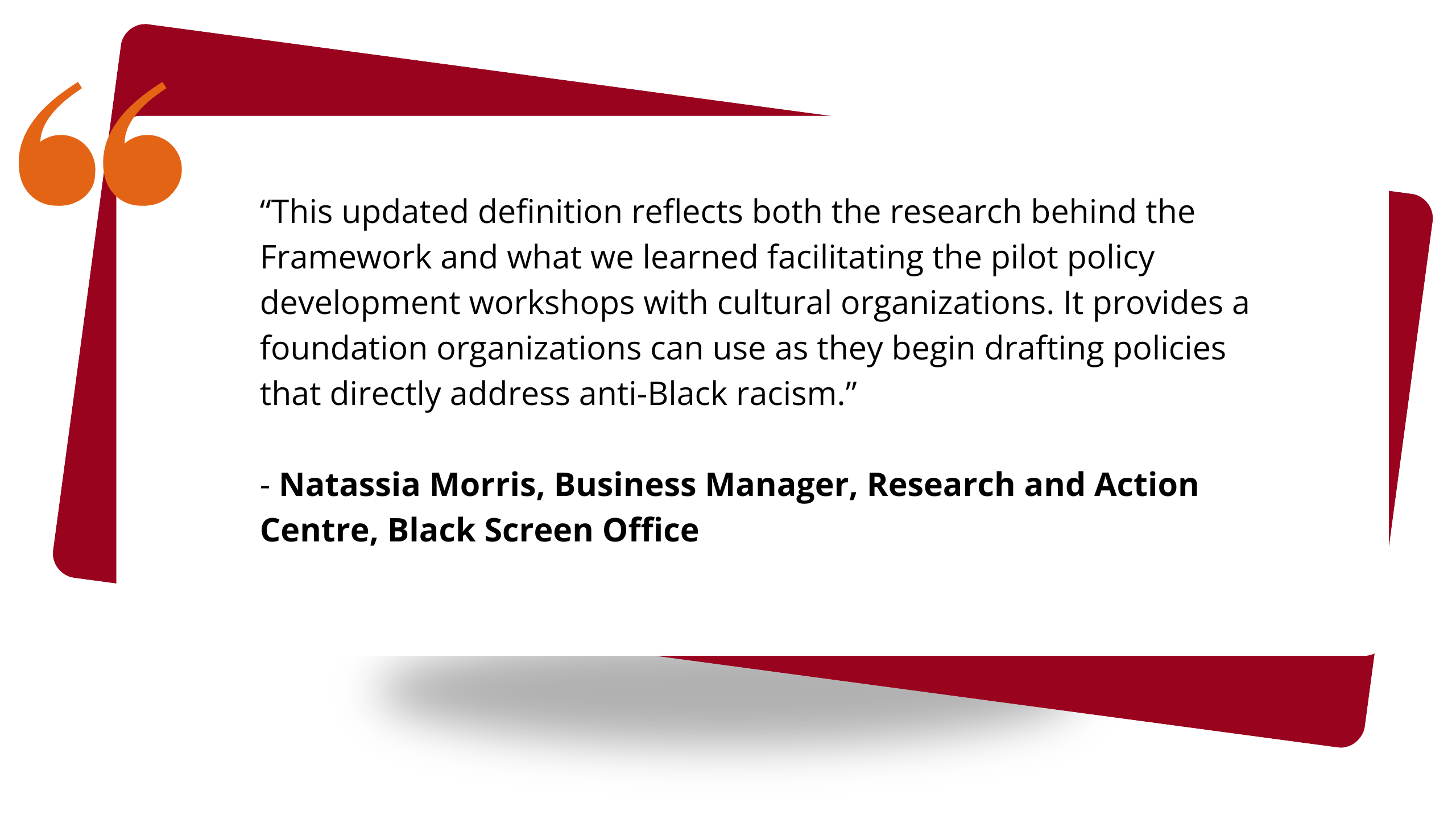
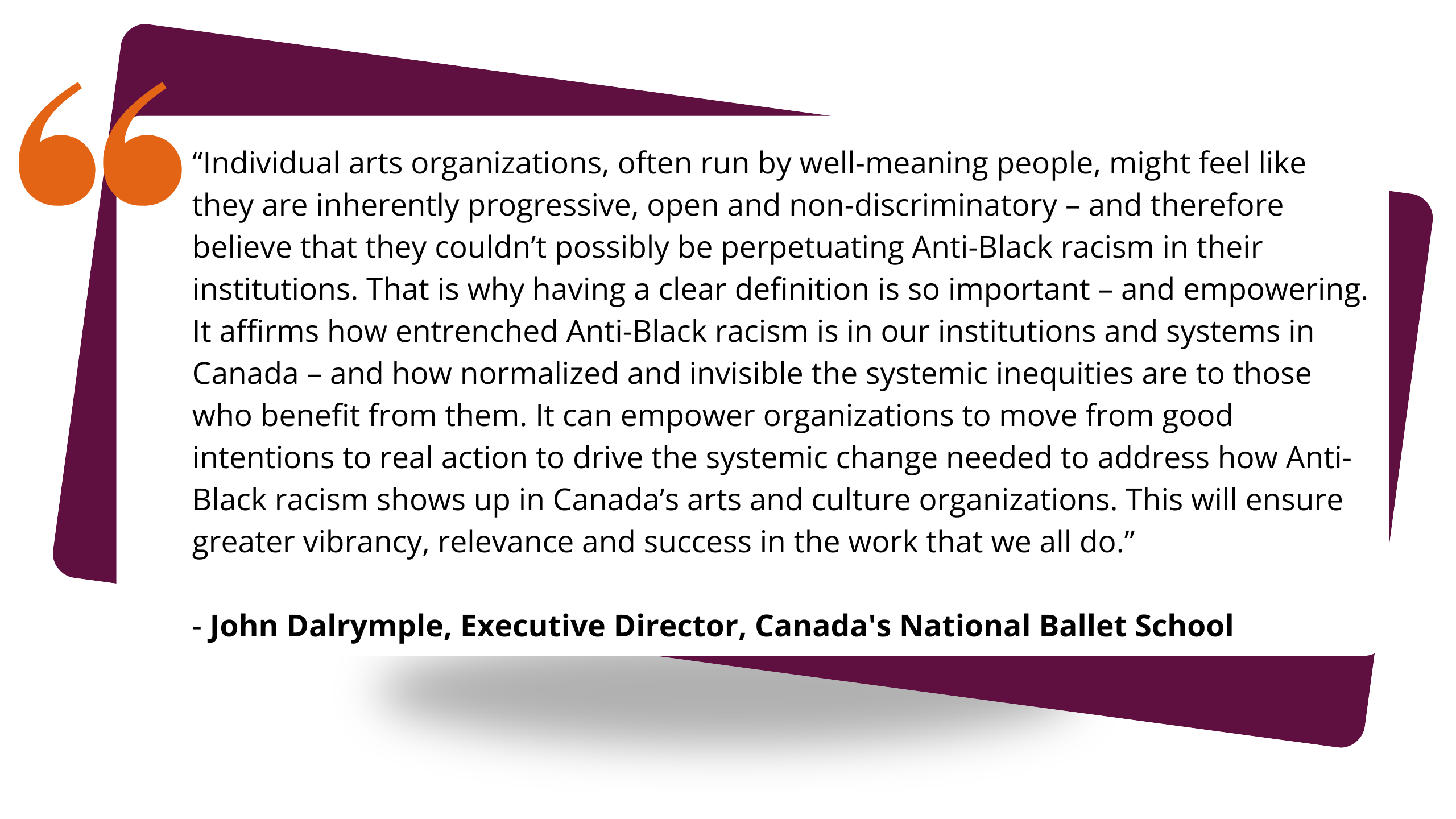
For that reason, the Black Screen Office is adopting an updated definition:
Anti-Black racism is prejudice, discrimination, and stereotyping directed at people of African descent, rooted in their history of enslavement, colonialism, and systemic inequities. It is deeply embedded in Canadian institutions, policies, and practices, often normalized or invisible to those who benefit from white supremacy. Its impact varies based on factors such as immigration status, language, religion, ability, gender identity, and sexual orientation. In the cultural industries, it appears as erasure and appropriation, with Black cultural influence often uncredited. It drives the social, economic, and political marginalization of Black Canadians, seen in unequal opportunities, lack of representation, lower socio-economic status, higher unemployment, poverty, health disparities, and overrepresentation in the criminal justice system.
This is a continuation of Dr. Benjamin’s work. It reflects what we now know, and what institutions can no longer afford to overlook.
Definition without action, however, is ritual.
On this March 21, we are calling for two concrete steps from institutions across Canada’s cultural industries.
Action A: Adopt, publish, and operationalize the updated definition
Require that all funding calls, commissioning briefs, and evaluation rubrics explicitly reference this updated definition.
Embed a concise definitions appendix in all policy and grant materials. Establish an annual public readout detailing how this definition shaped decisions, with a public-facing summary.
If a definition guides policy, the evidence should be visible.
Action B: Institute targeted accountability for representation and attribution
Set clear representation targets for Black leadership and decision-making within funding bodies, commissioning structures, and production pipelines and institute the necessary demographic data collection practices to support those targets. Publish annual progress dashboards.
Enshrine fair credit and attribution practices across all media forms. Audit for uncredited Black cultural influence and correct credits where needed.
Canada’s cultural industries shape national memory. They determine who is centred and who is peripheral. If our language is precise, our policies can be precise. If our definitions reflect structural truth, our institutions can move beyond statement and into accountability.
Modernization is not symbolic. It is operational.
Photo credit: Nicole Brumley; (2019).