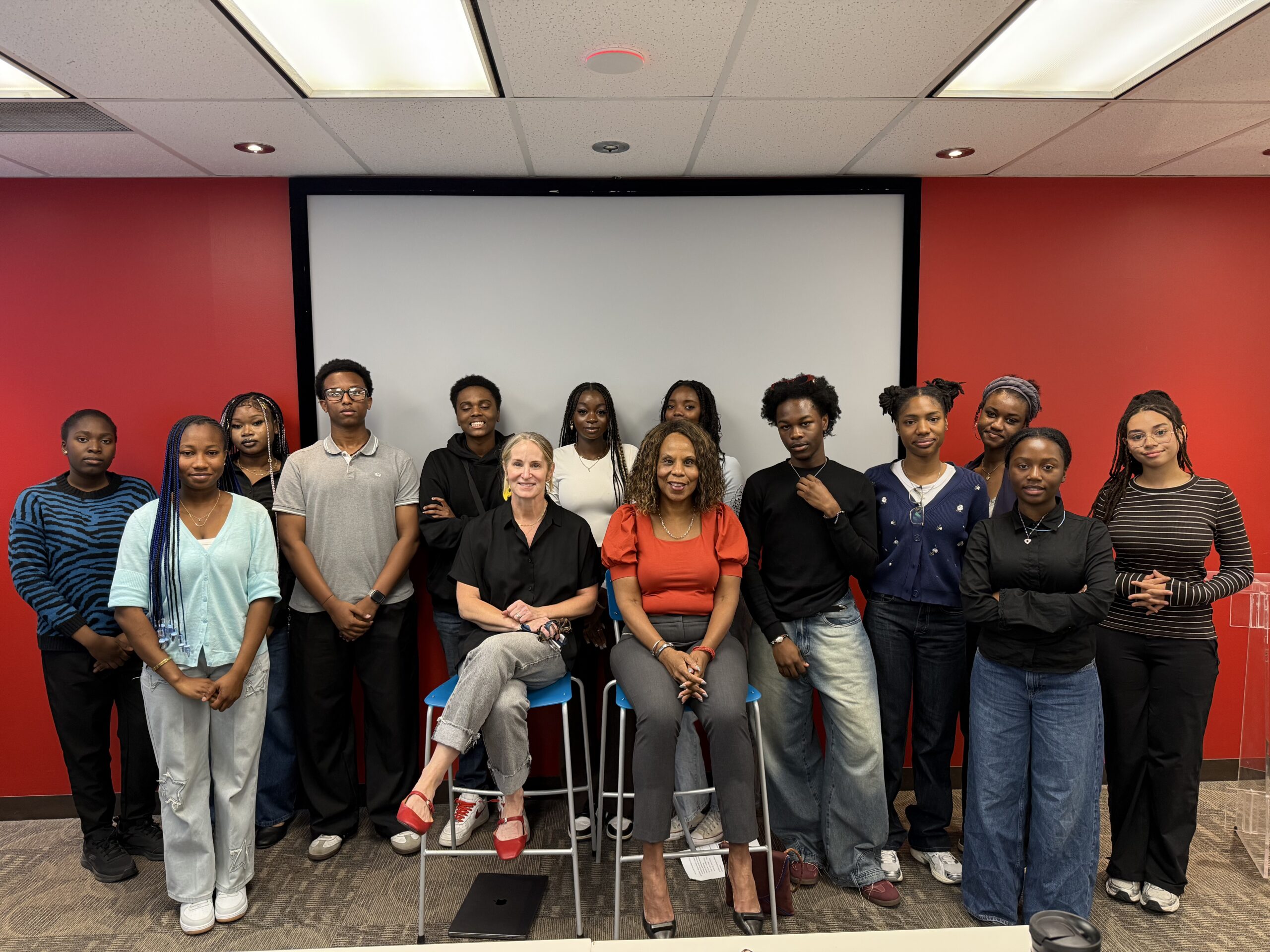
On July 31, Vanessa Case and I sat down with the students at TVO taking part in the Black Student Summer Leadership Program. I expected a good conversation. What we got was a room full of smart, engaged young people who were ready to challenge how the media industry works.
They had earned their place there.
The Black Student Summer Leadership Program is a paid employment and leadership initiative for Black students created by the Toronto District School Board’s Centre of Excellence for Black Student Achievement (CEBSA). Approximately 700 students applied this year, with about 200 accepted across two pathways. The program has grown considerably since it began in 2019, which says something about the demand for serious opportunities that allow Black students to test their interests, build their skills and see themselves in professional environments.
The five-week schedule at TVO was thoughtful, hands-on and extremely well organized. The students had spent their summer working alongside people who actually make media. They pitched and produced their own digital series, worked with the current affairs team on a segment about social media legislation, developed children’s shorts and screened a documentary to identify moments that could be adapted into vertical content for social platforms.
They loved making things. You could feel it.
That practical experience changed the quality of our conversation. These students were already thinking like creators, producers, marketers and audience strategists. They had seen how an idea moves through a media organization, and they had opinions about how the work could be stronger.
Vanessa opened the session by talking about her career across programming, production, acquisitions, streaming, digital platforms and public media. Her path has included major corporate transactions, bankruptcies, layoffs, global teams and the constant pressure to adapt as the industry changes.
One student asked her to explain mergers and acquisitions. Then the student went further: How had a merger affected Vanessa personally? What did she say to her teams? How did she lead people when their jobs and futures were uncertain?
That was a serious leadership question.
Vanessa answered with the candour it deserved. She spoke about navigating disruption, caring for teams and continuing to learn through major changes in the companies around her. Her career has been shaped by growth, risk, reinvention and more than one hard landing.
The students were equally direct about TVO.
One observed that TVO featured a lot of one-on-one interviews and suggested wrapping them around the subjects, styles and formats young people already enjoy on social media. In other words, make them more fun. Give the audience a reason to stop scrolling.
Another student asked why TVO was still on cable.
They did not have cable.
It was probably the most useful question any broadcaster could hear. Media organizations can spend months discussing digital transformation in boardrooms. A young audience member can cut through the language in five seconds: I do not watch you there, so how are you going to reach me?
These students understood that putting a television clip online does not automatically make it digital content. They were thinking about pace, format, personality and the habits of the audience. The industry needs that perspective in the room while content is being developed, rather than after everything has already been produced.
When it was my turn, I spoke about the Black Screen Office and the realities of building a career in film, television and digital media.
I started with my own connection to stories, going back to the stories my mother told me. My career has taken me through many corners of the industry, and the thread connecting them has been helping people bring stories to the screen.
I spoke about three things that shape careers: training, networks and access.
Training includes formal education, but much of this business is learned by doing. A set, production office, writers’ room or media organization teaches lessons that cannot be fully recreated in a classroom.
Networks matter because media is built through relationships. Talent and preparation are essential, and people also need opportunities to meet those who hire, finance, commission and champion the work.
Access means getting close enough to the industry to understand how decisions are made. It means meeting producers, broadcasters, funders, distributors and other decision-makers before you are expected to walk into the room with a perfect pitch and a complete professional network.
That is part of the work of the Black Screen Office. We support Black professionals through research, programs, industry relationships and advocacy. Our research has helped establish a clearer picture of who Black screen professionals are, what audiences expect and how Black communities want to see themselves represented.
One student asked what funding BSO had available for students trying to break into the industry.
It was the right question. The early-career gap remains one of the industry’s biggest weaknesses. Young people are constantly told to gain experience, yet many of the first opportunities are unpaid, informal or available mainly to people who already have connections.
The students did not want a vague invitation to “stay in touch.” They wanted to understand where the entry points were.
Many stayed behind after the session, anxious to connect and ask their own questions. Some were interested in film production. Others were drawn to entertainment, marketing, content creation or communications and were still figuring out where they fit. One student followed up to say they would happily begin as a production assistant or assistant to a producer or director. Another wanted exposure to TIFF so they could learn how the industry comes together around a major festival.
Their ambition was grounded. They were ready to start somewhere, learn the work and contribute.
BSO offered 20 tickets to the 2027 BSO Symposium so students can continue that exposure, meet people working across the industry and hear conversations about where Canadian screen culture is heading.
That kind of access can shift someone’s sense of what is possible. A student attends an industry event, hears a job title they had never encountered, meets someone whose career makes sense to them and begins to imagine a path.
TVO deserves credit for partnering in a program where Black students were trusted to make things, share their opinions and question the organization itself. They were treated as emerging professionals whose ideas had value.
The session also offered a glimpse of what the industry could gain by bringing young people into the conversation earlier.
These students know how their generation watches content. They understand the platforms. They can spot when something feels stiff, dated or disconnected from the audience. They are curious about the business behind the screen, including who holds power and how leaders behave when companies change.
They have plenty to learn. So does the industry.
The students were ready. Our job now is to make sure there is a real door for them to walk through.
By Joan Jenkinson, CEO, BSO
Supported by: